Typical checks
- Presence and absence
- Position and orientation
- Colour and shape
- Label and code presence
- Cap and closure presence
- Simple measurements
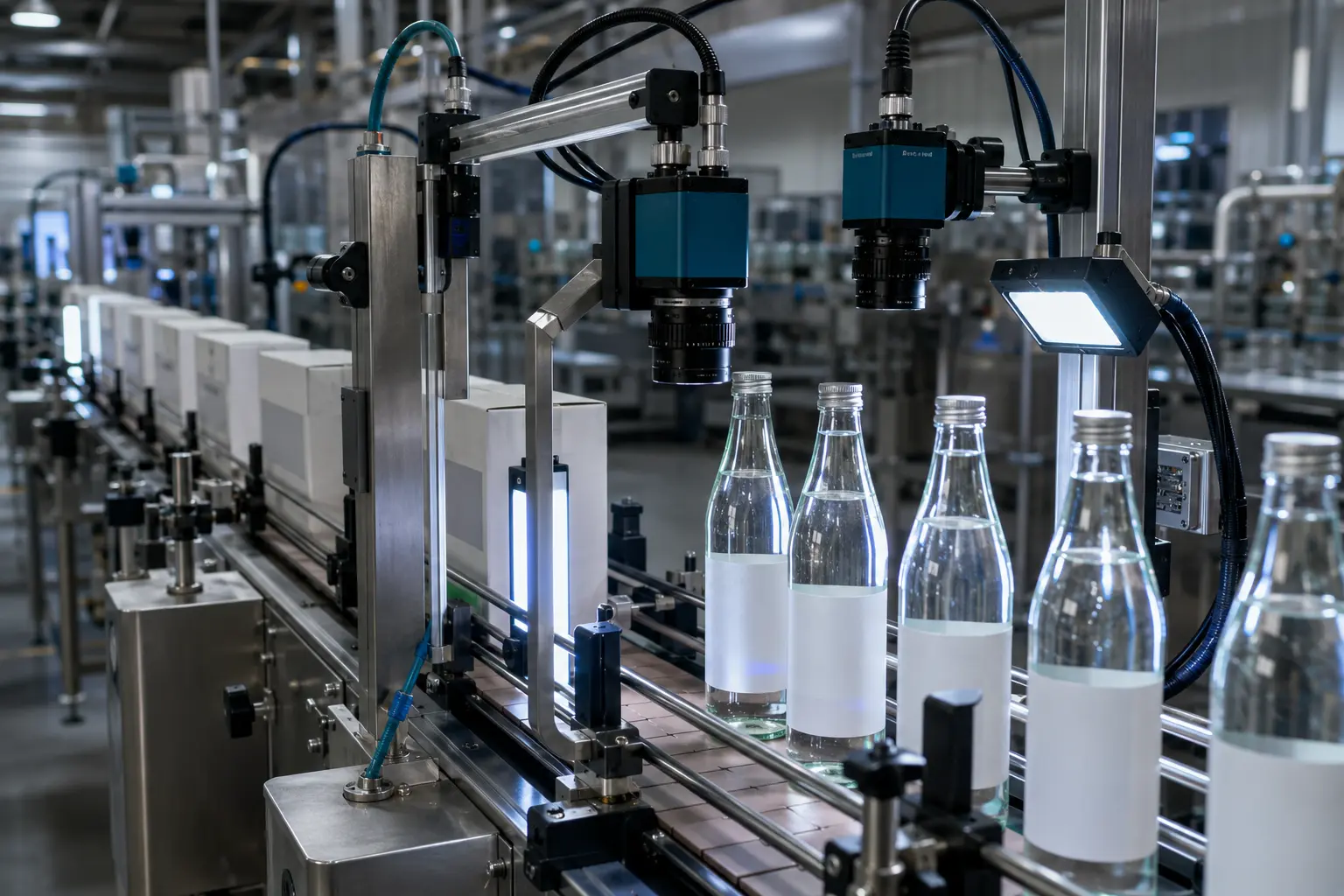
Deploy focused inspection close to the process with camera, processing and communications combined in a compact industrial package.
Smart cameras suit defined applications where a compact, maintainable inspection can deliver a clear decision. We engineer the complete station—including optics, lighting, mounting, triggering, operator controls, PLC signals and rejection—so the camera performs consistently on the line.
Each check is configured against agreed samples, tolerances and fault responses. Multiple checks can be combined into a single inspection recipe.
Confirm the inspection is sufficiently defined for a smart-camera architecture
Select lens, field of view and resolution against the smallest relevant feature
Control ambient light and reflections with purpose-designed illumination
Define PLC handshakes so lost triggers and late results generate a controlled fault
Provide accessible recipe management without exposing critical settings
Prove repeatability using production samples across the real process window
We reduce risk early by proving the inspection on representative products before final hardware, handling and controls are committed.
Agree the pack, defect, speed, reject risk, data needs and acceptance criteria.
Run feasibility tests using representative good, bad and borderline samples.
Design handling, cameras, lighting, controls, guarding and rejection as one station.
Build, validate, install, train and support the system in production.
Need an answer for your exact product or line? Send us the application details and we will identify the next useful test.
Ask an application questionA smart camera combines image acquisition, processing and industrial communications in one device. It can make local pass/fail decisions without a separate vision PC for many focused applications.
PC-based processing may be preferable for many cameras, high-resolution images, complex algorithms, extensive image storage, advanced interfaces or AI models. We select the architecture after reviewing the inspection.
Yes. Common integration uses digital I/O or industrial Ethernet, with defined result, ready, fault and recipe signals. The exact protocol depends on the selected camera and line controls.
Often it can, provided the features are visible in the same view and the cycle time is sufficient. Multiple views or lighting conditions may require additional cameras.
Send product details, target output, examples of acceptable and failed packs, and a short line video. We will define the most useful next technical step.